Sunday, February 27, 2022

Which Language Is Older Urdu Or Punjabi

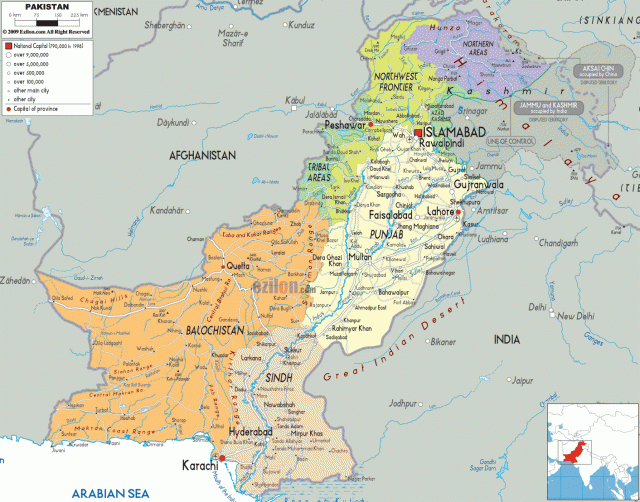
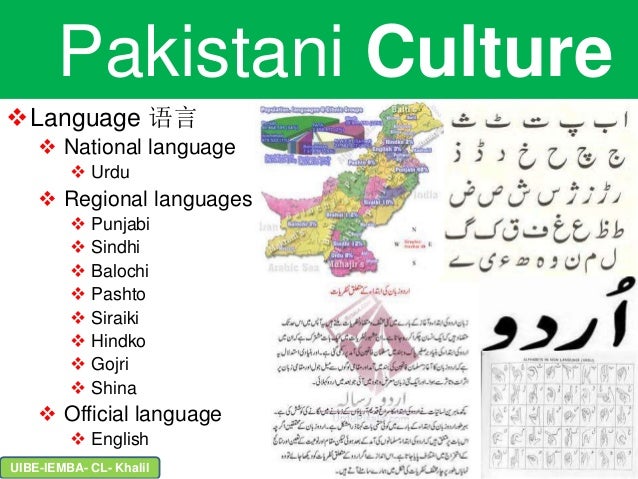
Regional languages are the main pillars of any state, they denote the cultural and linguistic diversity. Pakistan is a multilingual state with almost 74 languages spoken in the country , yet major emphasis has been laid on national and international language and little importance is given to the minority languages; which are distinct in every province. Hence, Urdu has acquired the status of dominant language; as most of the regional language speakers are acquiring the language for communicative competence . However, these language attitudes and language changes are more frequent in a multilingual language contact situation; mostly in the urban areas . Therefore, the present study explores the language attitudes and preference of third generation Sindhi and Gujarati speakers living in urban environment i.e. So, by comparative analysis, this study tries to figure out the possible reasons for the linguistic choices and factors for language shift among minority language speakers.

which language is older urdu or punjabi - Regional languages are the main pillars of any state

The research site selected for this study is a public sector university and the data for the study was collected using purposive sampling; initially twenty participants were selected, i.e. Sindhi and Gujarati male and female participants, who took part in this study by filling out the sociolinguistic profile form. In order to observe language shift at the individual level, in-depth, semi-structured interviews from were taken from eight participants using critical sampling. The recorded data was transcribed and analyzed qualitatively to identify major themes for the study.

which language is older urdu or punjabi - Pakistan is a multilingual state with almost 74 languages spoken in the country

Thus, this paper offers a comprehensive analysis of such a situation where young Sindhi and Gujarati speakers are shifting towards the mainstream Urdu and English language. Consequently, the vitality of Sindhi and Gujarati language has been challenged by the native speakers. In a few cases, it was observed that language loss may occur at any stage.

which language is older urdu or punjabi - Hence

These findings provide an opportunity to the language policy makers to redesign the policy of mother tongue education and promote home language. In addition, this research also draws attention of the Sindhi and Gujarati speakers to take immediate measures to transform and maintain their language in an urban environment. Therefore, steps should be taken by the minority language speakers and researchers to promote and preserve their historical language. Urdu, with more than 68 million native speakers, ranks as the eighteenth most spoken language in the world. It is the national language of Pakistan and one of the official languages of six India states.

which language is older urdu or punjabi - However

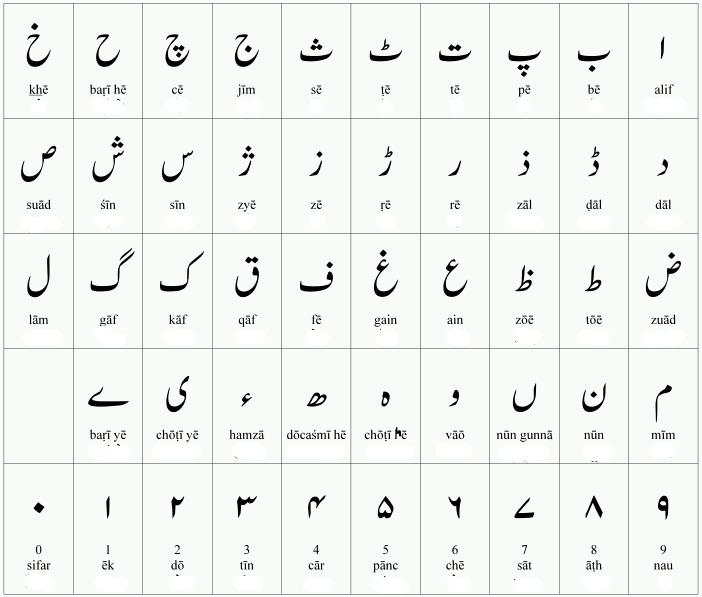
Urdu shares many linguistic features with other Indic languages that have Sanskrit as their ancestor, however, it uses Perso-Arabic script. It has a rich literature including a very popular form of love poetry called Ghazal, devotional and Sufi poetry, and is a main source to study, learn and appreciate Indo-Islamic cultural traditions. Urdu has also been used in Indian movies since the start of the movie industry. Furthermore, Urdu skills are crucial for understanding the political, religious, and social mindset of the Urdu speaking community. It is general human attitude that when an entity is made sacred or more worthy. They do not need any valid argument, they just claim it as there own entity.

which language is older urdu or punjabi - Therefore

The UP/CP leaders of British India along with East India company successfully linked religion with the languages. It was such an absurd idea at that time and it is still believed by many that Urdu is Muslim and Hindi is Hindu. This false dogma and in fact myopic approach nullified the established fact of linguistics that languages are linked with regions and the communities living in those regions. The Urdu Hindi controversy 1867 further aggravated the situation. Sir Sayyed Ahmed Khan and his Aligarh institute convinced the Indian Muslims that Hindustani when written in Persian script becomes a perfectly Muslim language and all other languages of British India are those of infidels.

which language is older urdu or punjabi - So

Muslims not only accepted Urdu whole heatedly but also started claiming it as there own. Even the books were written to prove the claims with references from classical poetry and other writings. On the other hand, the fact is, if you search on internet the word "khari boli" and play any video of that language, you would be surprised that it is same as Urdu. The khari boli is a native language which is spoken in the areas of UP/CP.

which language is older urdu or punjabi - The research site selected for this study is a public sector university and the data for the study was collected using purposive sampling initially twenty participants were selected

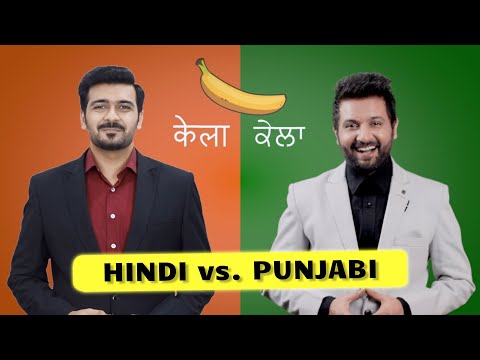
In spoken form the khari boli, Hindustani, Urdu and Hindi are different names of same language. But when we write the Hindustani in Devanagari script it is called Hindi, the language of Hindu community of British India and when we write the Hindustani in Persian script, it becomes the only representative language of Indo Pak Muslims. Of course, with the passage of time, the Hindi language has been stuffed with many Sanskrit words and Urdu with Persian and Arabic words, but, this is limited mainly to academics.
which language is older urdu or punjabi - Sindhi and Gujarati male and female participants

In common day to day dialogue, it is very difficult to differentiate whether a person is speaking Urdu or Hindi. The reason is languages are not classified on the basis of vocabulary as vocabulary keeps changing. The benchmark is the syntax and structure of sentences, which is exactly same in case of Urdu and Hindi. Tibetan literature has an uninterrupted history of at least 1300 years.
which language is older urdu or punjabi - In order to observe language shift at the individual level

It includes a vast corpus of indigenous works of great value for the academic study of literary genres, religious praxis, state formation, and the development of canonical systems. Classical Tibetan is duly famous as the medium for the largest, and most accurate, body of translations of Buddhist texts from India, the majority of which are lost in the original Indian languages. In addition to being essential for the study of Tibetan history, literature, art and religion, classical Tibetan is of scholarly value for the study of South Asian culture and history, Chinese history, and historical linguistics.
which language is older urdu or punjabi - The recorded data was transcribed and analyzed qualitatively to identify major themes for the study

Modern Tibetan is spoken by a population of approximately six million, in the Tibet Autonomous Region of the China, in other Tibetan cultural regions of China, and in the Tibetan diaspora . With the recent opening of Tibet to foreign travel and research, knowledge of modern Tibetan has become essential for students of any aspect of the region. There are numerous of modern spoken Tibetan, and the study of these dialects — essential for the study of cultural practices such as pilgrimage — is becoming an area of research at several institutions, including the University of Michigan.

which language is older urdu or punjabi - Thus

Sanskrit is the gateway to premodern, and especially pre-Islamic, India. It also served as a language of culture and religion and as a lingua franca in Central, East, and particularly Southeast Asia. It was carried into those regions along with the spread of Hinduism and Buddhism.

which language is older urdu or punjabi - Consequently

The position of Sanskrit in Asia can be likened to that of Latin in medieval and early modern Europe. Sanskrit is recognized as one of the official languages of India and every university there has a Sanskrit department. Sanskrit is of great value to the cultural self-definition of Hindu communities that have now spread across the globe.

which language is older urdu or punjabi - In a few cases

To children of Indian cultural background, Sanskrit opens the door to their classical culture. To academic students of Sanskrit, it is a gateway to the Hindu and Buddhist traditions, and to the pre-modern history of the subcontinent and beyond. Discovery of Sanskrit by the west in 1770s led to the development of Indo-European linguistics and reconstruction of the Indo-European language family and the cultural and religious pre-histories of Europe. Thus, the historical understanding of languages such as English requires some understanding of Sanskrit. Sanskrit is also the ancestor of a number of the South Asian languages taught at the University of Michigan, including Hindi, Punjabi, and Urdu. Bengali, with 189 million native speakers, ranks as the seventh most spoken language in the world.
which language is older urdu or punjabi - These findings provide an opportunity to the language policy makers to redesign the policy of mother tongue education and promote home language

It is the official language of Bangladesh and the Indian state of West Bengal. Bengali belongs to the Indo-European language family and, like many other Indian languages, has Sanskrit as its ancestor. Bengali is closely related to Hindi and Punjabi as they use the similar script, common vocabulary derived from Sanskrit, and the same word order. Bengali has a rich literary tradition that dates back to the 12th century. The famous Bengali philosopher and poet Rabindranath Tagore was awarded the Nobel Prize in literature in 1913.

which language is older urdu or punjabi - In addition

The Bengali movie industries known as Tollywood and Dhallywood are very popular because they produce good quality movies. Sindh is a multilingual province with Sindhi as its official language and Sindhi is the third most common language spoken in Pakistan. However, in the cities of the Sindh province, Urdu the national language, is widely spoken is in constant competition with other regional languages . Due to rapid urbanization and modernization, different communities are shifting to cities for better economic conditions.

which language is older urdu or punjabi - Therefore

Are Urdu And Punjabi The Same Language This study explores linguistic trends by investigating the language used by young Sindhi speakers in the city of Karachi and has used Fishman's domain model . The domain identifies the use of language in different settings between a range of interlocutors and the purpose of communication between interlocutors. The methodology used to collect data was both questionnaire and observation.

Are Urdu And Punjabi The Same Language

The results indicates that the use of other languages-Urdu and English is often noted in various domains. Even within the home domain Sindhi speakers are frequently using 'the other tongue'. This study encourages researchers to study language choices in contact situations in the urban cities of Pakistan. Punjabi has more than 90 million native speakers around the world and ranks as the tenth most spoken language in the world. Punjabi is the language of sacred scriptures of the Sikhs, the official language of the state of Punjab , and a language of Sikh and Sufi mysticism and of regional literature among Punjabi Muslims in Pakistan.

which language is older urdu or punjabi - It is the national language of Pakistan and one of the official languages of six India states

In Canada, Punjabi is the fourth most spoken language after English, French, and Chinese, while in the U.S. it is spoken by about half a million Punjabi and Sikh immigrants. It shares many linguistic features with other Indic languages that have Sanskrit as their common ancestor. Punjabi is taught at U-M using the Gurmukhi scrip, which has some similarities to Hindi.

which language is older urdu or punjabi - Urdu shares many linguistic features with other Indic languages that have Sanskrit as their ancestor

The Punjabi program at the University of Michigan is the oldest in the U.S. Punjabi language, Punjabi also spelled Panjabi, one of the most widely spoken Indo-Aryan languages. The old British spelling "Punjabi" remains in more common general usage than the academically precise "Panjabi." In the early 21st century there were about 30 million speakers of Punjabi in India. It is the official language of the Indian state of Punjab and is one of the languages recognized by the Indian constitution. In Pakistan Punjabi is spoken by some 70 million speakers, mostly in Punjab province, but official status at both the national and the provincial level is reserved for Urdu.

which language is older urdu or punjabi - It has a rich literature including a very popular form of love poetry called Ghazal

Despite Punjabi's rich literary history, it was not until 1947 that it would be recognised as an official language. Previous governments in the area of the Punjab had favoured Persian, Hindustani, or even earlier standardised versions of local registers as the language of the court or government. After the annexation of the Sikh Empire by the British East India Company following the Second Anglo-Sikh War in 1849, the British policy of establishing a uniform language for administration was expanded into the Punjab. The British Empire employed Urdu in its administration of North-Central and Northwestern India, while in the North-East of India, Bengali language was used as the language of administration. Despite its lack of official sanction, the Punjabi language continued to flourish as an instrument of cultural production, with rich literary traditions continuing until modern times. The Sikh religion, with its Gurmukhi script, played a special role in standardising and providing education in the language via Gurdwaras, while writers of all religions continued to produce poetry, prose, and literature in the language.
which language is older urdu or punjabi - Urdu has also been used in Indian movies since the start of the movie industry

According to the 2011 census, the number of people who speak Hindi as a mother tongue has increased in 2011 as compared to the 2001 census. In 2001, 41.03% of the people speak Hindi as mother tongue, while in 2011 it is increased to 43.63%. After Mandarin, Spanish and English, Hindi is also the fourth most spoken language in the world. It is spoken in almost all the states of the country including Uttar Pradesh, Bihar, Uttarakhand, Rajasthan, Madhya Pradesh, Chhattisgarh, Himachal Pradesh and Delhi. Urdu belongs to the Indo-Iranian language family, which is spread all across Central Asia, South, West, and Southeast Asia.

which language is older urdu or punjabi - Furthermore

It is spoken by close to 250 million native speakers and is learned by over 100 million more as a second language. It is the official language of Pakistan and one of two official languages in India. Do you know that there are 121 languages that are spoken by 10,000 or more people in India, which has a population of more than 121 crores, according to a census analysis? More than 19,500 languages or dialects are spoken in India as mother tongue, according to the analysis of a census.

which language is older urdu or punjabi - It is general human attitude that when an entity is made sacred or more worthy

Let us find out the most spoken languages and speakers in the country as per 2011 Census. There are 260 million speakers of Hindi, making it the fifth most spoken language in the world. Outside of India, it is spoken by a substantial population in Bangladesh, the U.K., the U.S., and thirteen other nations. It has an old and rich literature that dates back to late Medieval period. Hindi is also the main language of the Bollywood film industry, which produces an astounding number of movies on a variety of topics every year. The Bollywood movie industry has greatly contributed to popularising Hindi around the world.

which language is older urdu or punjabi - They do not need any valid argument

Other languages were cultivated for most kinds of writing, including Persian under the Mughal Empire, then Urdu during the British period and, in Pakistan, continuing to the present day. In most other Indo-Aryan-speaking areas of South Asia, the modern period saw overlapping local dialects being grouped into strictly defined provincial languages, but this process has taken much longer to happen in Punjab. Urdu is a mixture of Persian language and Arabic used as the main languages of Muslim culture. It is considered by many to be a genius linguistic masterpiece. With its rich vocabulary, it has been able to adapt over time to the regional languages and culture of South Asia.

which language is older urdu or punjabi - The UPCP leaders of British India along with East India company successfully linked religion with the languages

The Urdu language was created in 1844 by a Muslim scholar, Mir Ameer Ali Khan Shere Ali, who wanted to make the Arabic script workable for the different languages of India with an aim for unification. This resulted in creating a new alphabet from scratch from English letters. Urdu is predominantly a spoken language with an emphasis on written literature.
which language is older urdu or punjabi - It was such an absurd idea at that time and it is still believed by many that Urdu is Muslim and Hindi is Hindu

In Pakistan, it is used as a language of government, education, and culture. Punjabi belongs to the Indo-Aryan language family, which is spread all across India, Pakistan, and Southeast Asia. It is spoken by close to 90 million native speakers and is learned by over 10 million more as a second language. It is one of the 22 official languages in Pakistan and one of the official languages in India, as well as having a large number of native speakers in Bangladesh and Nepal.

which language is older urdu or punjabi - This false dogma and in fact myopic approach nullified the established fact of linguistics that languages are linked with regions and the communities living in those regions

In September 2015, a case was filed in Supreme Court of Pakistan against Government of Punjab, Pakistan as it did not take any step to implement the Punjabi language in the province. Additionally, several thousand Punjabis gather in Lahore every year on International Mother Language Day. Thinktanks, political organisations, cultural projects, and individuals also demand authorities at the national and provincial level to promote the use of the language in the public and official spheres. As various types of languages are spoken in India and there is no hindrance in the medium of communication between the speakers because most Indians are multi-lingual. It has been seen that most people of India speak English, Hindi, and one mother tongue.

which language is older urdu or punjabi - The Urdu Hindi controversy 1867 further aggravated the situation

Now, English is no longer considered a foreign language because it is popular as the most common way of communication between people in the south and the north of India. So, now you may have come to know about the most spoken languages in India by the number of speakers. The article covers the differences between Urdu and Punjabi, two languages that are closely related.
which language is older urdu or punjabi - Sir Sayyed Ahmed Khan and his Aligarh institute convinced the Indian Muslims that Hindustani when written in Persian script becomes a perfectly Muslim language and all other languages of British India are those of infidels

The article also covers the history of both languages, the similarities they share with other Indo-Aryan languages, their scripts, and their grammar. Urdu and Punjabi share close linguistic similarities as well as cultural ones with each other, which can be seen through their shared history and literature. However, they still maintain their differences in terms of literature and culture, which contribute to their significant distinctions in spoken language as well as written form as well as grammar difference between the two tongues. Punjabi is a language spoken by millions of people in over ten countries, mainly in the northern region of South Asia.
which language is older urdu or punjabi - Muslims not only accepted Urdu whole heatedly but also started claiming it as there own

Friday, January 21, 2022

What Are The Different Types Of Modal Verbs And Their Functions

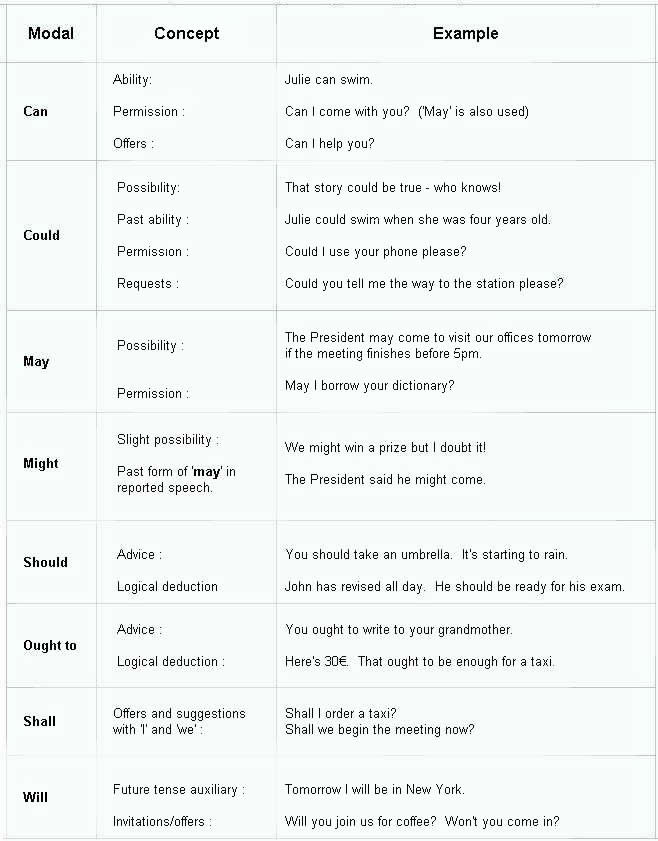
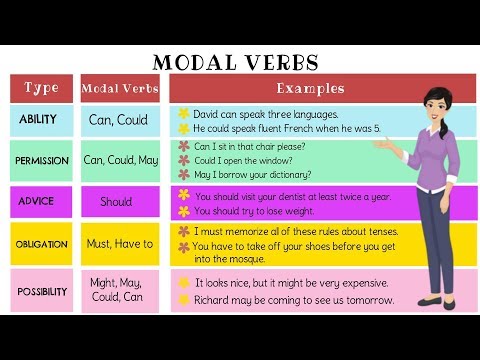
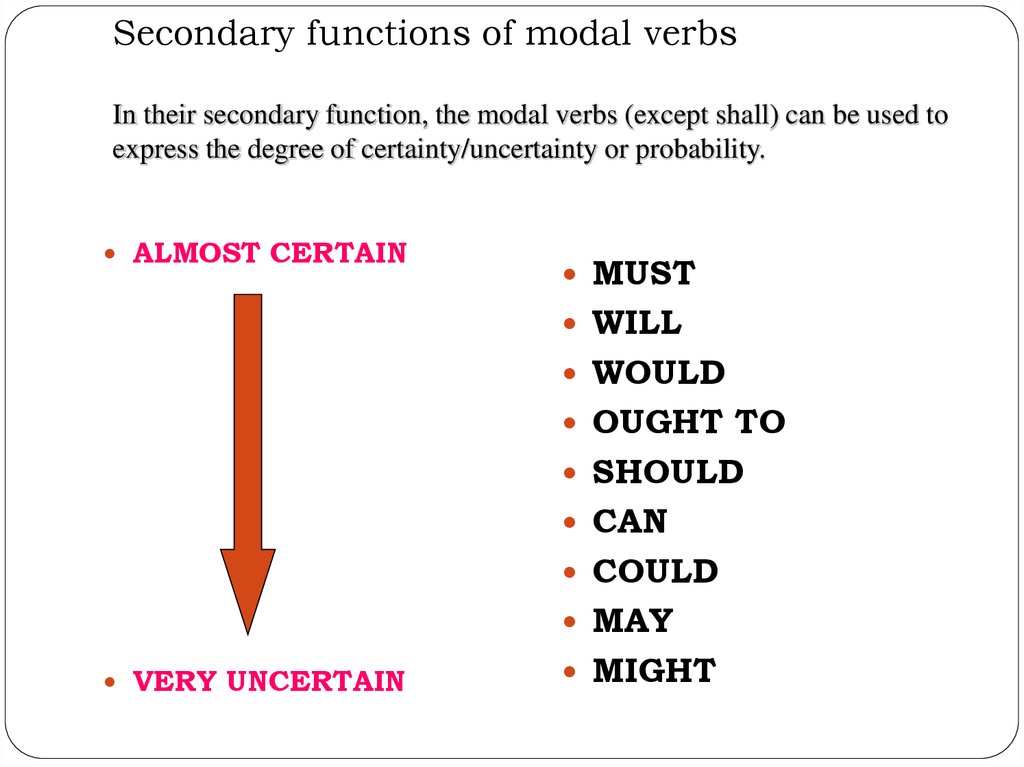
In English, modality is primarily conveyed through modal auxiliary verbs such as can, could, will, and must, among others. Certain modal verbs can serve several modality functions. For example, can is often used as an alternative to other modals to express ability (e.g. Dogs can swim), possibility (She could/can use the ladder to get up on the roof), and permission (You may/can go outside and play now) . English modals are not inflected for person or number agreement with the subject. In some instances, these distinctions correspond directly with events in time, as in can/could in I can run the mile in six minutes, but when I was younger I could run it in five minutes. However, the correspondence between formal tense and events in time is not straightforward, as we discuss below.

what are the different types of modal verbs and their functions - In English

Our end-to-end longitudinal study has provided more detailed information and has captured more nuanced usage trends and changes over different time periods. Most crucially, we are also able to reconcile some of the discrepancies and provide possible explanations for the remaining inconsistencies between the two previous studies by Leech and Millar . Through the consideration of decade-to-decade trends in Tables 6 and 9, this study has shown that most modal verbs were decreasing. Based on the value assignments of modal verbs , would is assigned median value in the literature but could be assigned a low value according to the level of commitment interpretation we gave earlier in this paper.

what are the different types of modal verbs and their functions - Certain modal verbs can serve several modality functions

In other words, the English language showed a clear trend of moving from modal verbs that require high-low power relations and demand high levels of obligations. The overall decrease of high and median value modal verbs is partially compensated by the increasing usage of low value modal verbs. In other words, the written discourse is moving from high value demands of obligations to low value non-committing peer perspectives. Following Leech's hypothesis that the language use trends reflect the societal move to more open and equal interaction, our dichotomy of low value versus high/median modals should provide an even more nuanced account.

what are the different types of modal verbs and their functions - For example

In addition, in terms of functional compensation of linguistic changes and empowering the speakers, the increasing use of low value modal verbs is also predicted. Among the low value modal verbs, can and could can be argued to be more empowering than may and might according to their meaning. The ability meaning of can and could implies that addressees have the power to act volitionally. On the other hand, may and might have basic meaning of giving permissions and are often used in hypothetical and hedging contexts, thus leaving the volitional power of the addresses unspecified. In other words, our data is not only more reliable but also better aligned with theoretical predictions.

what are the different types of modal verbs and their functions - English modals are not inflected for person or number agreement with the subject

The general consensus on theoretical issues of the analysis of modal verbs and the correlation of their usages to social changes was formed after Leech's response and described earlier in this paper. The corpus choice and data sampling method issues, however, have important implications for our current study. In terms of corpus size and coverage, Millar pointed out the advantage of scaling up, which has been empirically verified by recent corpus-driven studies, many adopting the Web-as-Corpus approach . In addition, in studies of variations and changes, the density of sampling vs population is a critical issue as one can never be sure if the change between two sampling points is simple and monotonic, or complex and multi-dimensional.

what are the different types of modal verbs and their functions - In some instances

This can be viewed as another constant source of Galton's problem; that is, we can never be sure if the change between two points of direct comparison is the result of a direct causal change or the sum of a series of changes. One possible solution to this issue is to have longitudinal continuous sampling for an end-to-end study. That is, one could design the study to examine all data based on fixed diachronic periods, thus ensuring that all data and all times are accounted for. The Google Books corpus is arguably the single most comprehensive corpus in the world and also supports longitudinal continuous sampling. The early version of the Google Books corpus contains 5,195,769 digitized books and over 500 billion words containing 4% of all books ever published. The 2012 version contains data from 8,116,746 books covering 6% of all books ever published .

what are the different types of modal verbs and their functions - However

Despite some limitations, such as the quality of metadata and occasional OCR errors, the Google Books corpus still offers new research potentials . This corpus also helps to solve the challenge of lacking large enough historical corpora for diachronic studies of low-frequency words . Several studies have been directed at English-speaking children's early use of modal verbs. According to the work of Wells , Kuczaj , and Richards , can seems to emerge earlier and is used more frequently than other modals, with the exception of its negative counterpart, can't. The modal can is often used in interrogatives to request permission.

what are the different types of modal verbs and their functions - Our end-to-end longitudinal study has provided more detailed information and has captured more nuanced usage trends and changes over different time periods

In declaratives, can is used most frequently to express the notion of ability, though often this use falls somewhere on a continuum between ability and circumstantial possibility . It appears that can is the first modal to be used by children to express these notions, and each of these notions is expressed by age 2;6 . Papafragou has suggested that notions such as ability and permission are acquired earlier than functions that reflect epistemic modality because they do not require children to reflect on their own mental states. Palmer , states that modal auxiliary verbs help language users express 'what should be', 'what may be', 'what would be', and 'what is'. Thus, the authors of the articles make frequent use of modal verbs to show possibility, necessity and prediction in their writing.

what are the different types of modal verbs and their functions - Most crucially

As the results in the frequency table indicates, the authors of articles on covid-19 use more will to indicate prediction. Will accounts for 28.9% of the modal auxiliary used and this is the highest percentage. Modality involves the claims or assertions of a person assuming the position of authority and claiming or asserting to have the knowledge of what will happen in future. On this basis the results given the use of modal auxiliarywill indicates what will happen in future.

what are the different types of modal verbs and their functions - Through the consideration of decade-to-decade trends in Tables 6 and 9

Following Labov , Leech initiated the data driven approach to investigate the effect of social changes on language uses, focusing on the attitudinal expression of modal verbs. Taking advantage of the availability of a larger corpus, as well as the ubiquity of language big data, this paper joins the emergent trend of using linguistic evidence to identify environmental and societal changes . In this study, we also improved the methodology of language big data based diachronic analysis of a language and established a robust and accessible way to monitor changes through modal verbs as social context specific linguistic devices. We showed that this kind of longitudinal tracking of changes in language use, especially in modal verbs, is a powerful tool to monitor social and cultural changes.

what are the different types of modal verbs and their functions - Based on the value assignments of modal verbs

Our comparative analysis of English and Chinese firmly establishes the correlation between modal verb usages and societal changes. The availability of large-scale diachronic digitized corpora facilitates the corpus-based approach to the study of language changes [2–6]. Corpus-based approaches are not only typically based on strong empirical evidence, but also often rely on quantitative modeling . The availability of historical corpora also allows end-to-end longitudinal studies to focus on a particular period of interest.

what are the different types of modal verbs and their functions - In other words

In this context, historical corpora can be considered as perhaps the only continuous chronological databases of collective human behavior changes . As such, quantitative research of language changes can be a useful tool to explore the impacts of historical events and social evolution . However, such studies have focused on English and a few European languages, typically covering less than 100 years and focusing only on a few words, and rarely adopt end-to-end longitudinal approaches [14–17]. In Cantonese, modals usually appear before the main verb, as in English. The morphemes serving as modals are not marked for tense and do not change as a function of the present or past nature of the event.

what are the different types of modal verbs and their functions - The overall decrease of high and median value modal verbs is partially compensated by the increasing usage of low value modal verbs

In this study, we examined children's use of two modals, sik1 and ho2ji5. The modal sik1 expresses ability, and is similar to can when used in contexts meaning 'is able to' or 'knows how to'. The modal ho2ji5 is used in contexts pertaining to permission. Although Cantonese and English can convey essentially the same modality functions, Cantonese differs from English in how these functions are divided among the modals of the language. The modal ho2ji5, frequently used for permission, can be extended to the function of possibility. However, it does not convey the sense of ability, unlike English can which is applicable to ability as well as permission and possibility.

what are the different types of modal verbs and their functions - In other words

The data was analyzed manually with regard to different functions of the modal auxiliary verbs in question. Six categories of modal auxiliaries namely; Ability, possibility, prediction, obligation, intention and quasi-legal modals characterized the data. Findings indicate that the authors of the articles chose predictive auxiliary modals will, may, can and should in that order in the articles. The modals used presented the opinions of the article writers and the use of will reported the highest frequency.

what are the different types of modal verbs and their functions - Following Leechs hypothesis that the language use trends reflect the societal move to more open and equal interaction

Modal verbs are useful devices to evince the authors' stance concerning the propositional content (Biber et al., 1999; Palmer, 2001; Collins, 2009); therefore, these verbs can report on perspectivisation in introductions and conclusions. In this context, we expect that probability modal verbs entailing tentativeness will occur more frequently in introductions and necessity modals should appear more frequently in conclusions. Research on the use of modal verbs in these two sections of the research article has been conducted using corpus tools for text retrieval and analysis. Variation ratios will be evaluated using a log-likelihood test to determine the significance of variation according to whether specific modal meanings appear in the introductions or the conclusions. Our main research questions are 'How does the use of modal verbs vary in the introduction and conclusion sections of scientific tourism research articles in terms of form and meaning?

what are the different types of modal verbs and their functions - In addition

' and 'How does the use of modal verbs vary in the introduction and conclusion sections of scientific tourism research articles in terms of the functions they fulfil? We can think of three ways to examine modal use in a manner that separates modality and formal tense to the greatest extent possible. The first, pursued in Study 1, is to examine children's use of different modality functions that can be expressed using the same modal with the same tense value (non-past). The second, explored in Study 2, is to examine the use of modals by children with SLI when tense is clearly not involved. Notions of past time, for example, must be established by means other than by verb tense, such as by use of temporal adverbs. Therefore, unlike English modals, any difficulty that Cantonese-speaking children with SLI exhibit in the use of modals cannot be attributed to problems with tense.

what are the different types of modal verbs and their functions - Among the low value modal verbs

The third way is to examine children's use of the same modality function in contexts that require either a modal with the formal tense value of past or a modal with the formal tense value of non-past . In all three studies, children with SLI are compared to a group of typically developing same-age peers and a group of typically developing children approximately two years younger. The present study examines modal verb meanings and variation in these verbs in a corpus of texts in the field of tourism. We use a compilation of article introductions and conclusions written in English and published in leading journals specialised in tourism studies. Modal verbs are important to evince the authors' stance concerning the propositional content (Biber, Johansson, Leech, Conrad & Finegan, 1999; Palmer, 2001).

what are the different types of modal verbs and their functions - The ability meaning of can and could implies that addressees have the power to act volitionally

Variation ratios will be evaluated using a log-likelihood test to determine differences in significance between occurrences in introductions and conclusions. Our conclusions will report, therefore, on the forms, meanings and functions of modal verbs in the sections analysed. Research has been conducted using corpus tools to obtain evidence from our sub-corpus of introductions and conclusions, as mentioned earlier. Direct visual inspection of the texts has also been vital to identify the meaning of the modal verbs in context. The fundamental role of the context in specifying the sense a particular modal verb entails has been mentioned in the literature (see Huschová, 2015; Alonso-Almeida, 2015a and the references therein). A modal verb may indicate an array of meanings, and therefore without these contextual cues, it would be unreasonable to expect an accurate categorisation of these verbal forms.

what are the different types of modal verbs and their functions - On the other hand

The plasticity of modal verbs makes them unique; however, it also challenges our ability to identify the meanings they involve each time. In addition to these senses of modal verbs, there is another aspect that cannot be achieved through an automatic interrogation of a computerised corpora, and this is the function these verbs fulfil in the texts in which they appear. All modal auxiliary verbs are followed by a main verb in its base form ; they can never be followed by other modal verbs, lone auxiliary verbs, or nouns. Our second research question deals with potential differences in usage trends of modal verbs according to their modality values of high, median, and low.

what are the different types of modal verbs and their functions - In other words

Note that our first study based on English showed that the frequency of low value modal verbs rises while the other two types fall in Table 6. We speculated that the rise of low value modal verbs is due to the exact reason that Leech suspected, i.e. the opening up of society. The Chinese data not only provide further support of correlation but also showed a more nuanced picture that challenges the somewhat simplistic view assumed by previous studies.

what are the different types of modal verbs and their functions - The general consensus on theoretical issues of the analysis of modal verbs and the correlation of their usages to social changes was formed after Leechs response and described earlier in this paper

First, our data shows that in the 1940s, when China was at war and in turmoil, an authoritative turn did reverse the direction of change, with high value modal verbs increasing and the other two values decreasing. This result reinforces our hypothesis that high and low value modal verbs could move in opposite directions. However, modal verb frequency may also slowly decrease naturally over time after a drastic rise. Hence, how to predict the overall tendencies of modal verb usage changes remain an intriguing question.

what are the different types of modal verbs and their functions - The corpus choice and data sampling method issues

As 可以 kěyǐ 'may' is from vernacular language and rarely used in classical Chinese, the switch to writing vernacular language certainly played a role in its increased usage, among other vernacular terms. However, the question of why 可以 kěyǐ 'may' had such a drastic increase remains unanswered. Refining Leech's original hypothesis and based on our elaboration of the value of modal verbs, we argue that 可以 kěyǐ 'may' marks empowering events. 可以 kěyǐ 'may' has a range of meaning slightly wider than the English may.

what are the different types of modal verbs and their functions - In terms of corpus size and coverage

That is, in addition to granting permission, 可以 kěyǐ 'may' can also be used in affirmation of ability/potential (more like 'are able to'). As such, the giving of permission and the affirmation of ability are two crucial aspects of empowering individuals. This pattern of findings suggests a three-step process for intervention aimed at assisting children in their acquisition and use of modals.

what are the different types of modal verbs and their functions - In addition

First, clinicians might provide children with a modal form for each of the major modality functions served by modals in the child's language. (It is possible, for example, that in Study 1 and 2, a few children simply had no knowledge that modals can express ability.) Second, activities might be provided that acquaint children with the multi-functional nature of certain modals. Otherwise, children might unduly restrict their use of particular modal forms (e.g. can only in permission contexts, could only in possibility contexts). Finally, children may need assistance in learning and using two different modal forms when the same modality function (e.g. ability) must be used in past as well as non-past contexts. Determination of the procedures most appropriate for these intervention goals must be discovered through future research. However, given the general success shown by the OTD children in the present investigation, the types of contexts employed here might be considered as a useful starting point.

what are the different types of modal verbs and their functions - This can be viewed as another constant source of Galtons problem that is

In Study 1, we found that English-speaking children with SLI were as proficient as YTD children though less proficient than OTD children in the use of the modal can to express the modality functions of ability and permission. In Study 2, the same modality functions were studied in the speech of SLI, YTD, and OTD groups who were speakers of Cantonese. In this language, tense is not employed, and therefore the modality function could be examined independent of formal tense. In Study 3, we again studied SLI, YTD, and OTD groups in English, to determine whether the children's expression of ability differed across past and non-past contexts.

what are the different types of modal verbs and their functions - One possible solution to this issue is to have longitudinal continuous sampling for an end-to-end study

The results for can replicated the findings from Study 1. However, the children with SLI were significantly more limited than both the YTD and OTD groups in their use of could. There is also a separate section on the Modal Auxiliaries, which divides these verbs into their various meanings of necessity, advice, ability, expectation, permission, possibility, etc., and provides sample sentences in various tenses. See the section on Conditional Verb Forms for help with the modal auxiliary would. The shades of meaning among modal auxiliaries are multifarious and complex. Most English-as-a-Second-Language textbooks will contain at least one chapter on their usage.

what are the different types of modal verbs and their functions - That is

For more advanced students, A University Grammar of English, by Randolph Quirk and Sidney Greenbaum, contains an excellent, extensive analysis of modal auxiliaries. Modal auxiliary verbs are used to show a necessity, capability, willingness, or possibility. Unlike most verbs, there is only one form of these verbs.

what are the different types of modal verbs and their functions - The Google Books corpus is arguably the single most comprehensive corpus in the world and also supports longitudinal continuous sampling

What Are The Different Kinds Of Modals And Their Uses Typically, verb forms change to indicate whether the sentence's structure is singular or plural. Most verbs also indicate whether something happened in the past, present, or future. This is not the case with most modal auxiliary verbs, which makes them simpler to understand and use correctly.

What Are The Different Kinds Of Modals And Their Uses

This study is designed to reconcile the conflicting results of these two classical studies in order to underline the advantage of our new methodology driven by access to language big data. Theoretically, we also address the ongoing balance versus size debate in corpus linguistics, especially in the context of diachronic studies. By adopting the Google Books corpus, we show that the size and balance data can be optimized given sufficient sampling size. In addition, two additional facts corroborate the account. First, interestingly, the orthography reform did not seem to have a strong effect on the use of modal verbs.

what are the different types of modal verbs and their functions - The 2012 version contains data from 8

A possible explanation is that the metalinguistic change does not directly affect interpersonal relations, hence there is no direct effect on the use of modality. This explanation can also be applied to other major historical events in the past century. Second, we also observed that in the decades without major change instigating events, the general usage tendency is a slow decrease with some fluctuations, of modal verbs overall, including the types that just changed. This pattern can be predicted by the hypothesis that the major changes were the consequences of major social-historical events. That is, once the memory and effect of the instigating event fade through time, the corresponding changes in modal verb usages will also fade slowly. Even though the study of English modal verbs has proven the correlation between social changes and language use, no such exploration has been conducted with Chinese.

what are the different types of modal verbs and their functions - Despite some limitations

Surge Protector For

Keeping your electronics {protected from|shielded from|protected against} {dangerous|harmful} {power|energy} surges is {super|tremendous} {e...